Maria Gavriilaki, Thessaloniki, Greece
Hosting department: Movement Disorders Unit, Pitié-Salpêtrière University Hospital, Paris, France
Supervisor: Prof. Marie Vidailhet
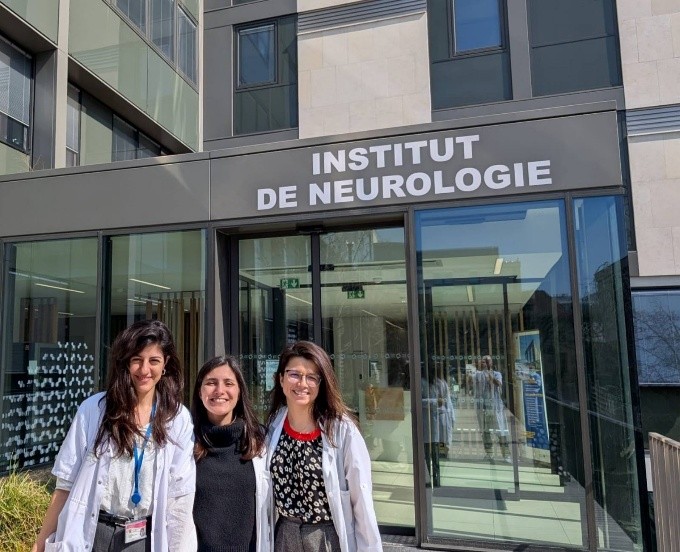
Thanks to the invaluable support of the European Academy of Neurology, I have just completed my three-month EAN Clinical Fellowship at the Movement Disorders Unit of Pitié-Salpêtrière University Hospital in Paris—a historic institution synonymous with neurology’s heritage. Working in the very place where Charcot, Babinski, and Lhermitte once practiced—and seeing their names honoured on buildings—was truly inspiring.
Throughout this fellowship, my time was mainly devoted to outpatient consultations, working alongside renowned experts in the field in the evaluation and treatment of a wide range of movement disorders, from Parkinson’s disease, dystonia, myoclonus, and tremor to functional neurological conditions. I also participated in the neurogenetic clinic, deepening my understanding of ataxia, hereditary spastic paraplegia and the principles of genetic counselling. Because of the Pitié’s reputation, it draws patients from all over the country and beyond, many of which present with rare genetic and complex movement disorders.
Over the course of three bustling months in Paris, a key focus of my training was the therapeutic approaches, particularly botulinum toxin injections under both EMG and ultrasound guidance. Prof. Marie Vidailhet, a pioneer in the use of toxin for the treatment of dystonia, provided invaluable mentorship. When I arrived, I was unfamiliar with muscle ultrasound, but through practical and supervised exposure, my confidence and precision in performing this procedure significantly improved; ultimately mastering the technique.
Although not the primary aim of my fellowship, I had the incredible opportunity to engage in further learning in the field of nerve conduction studies and EMG, focusing on peripheral and neuromuscular diseases, which is my other area of interest, under the guidance of Dr Delorme. In addition, I was introduced to movement disorder neurophysiology with the use of polymyography combined with accelerometry.
Finally, I gained insight into advanced therapeutic approaches offered in Pitié-Salpêtrière to movement disorders patients, including deep brain stimulation and MR-guided focused ultrasound. The structure of weekly clinical rounds, outpatient clinics, and dedicated educational activities was organised to ensure frequent and meaningful interaction with all faculty members. Academic discussions, multidisciplinary meetings, and access to historical resources like the Charcot Library enriched the learning experience further.
Beyond my clinical duties, I took the opportunity to explore Paris—not just as a visitor, but occasionally as a flaneur, taking in the rhythm of daily life. I visited museums, walked along the Seine, and enjoyed the city’s unique blend of history, art, and atmosphere. Throughout this experience, I also made new friends from all over the world, including my fellow ‘buddy’ Diana who supported me throughout my stay. The EAN grant played a crucial role in easing the burden of rent in Paris.
This fellowship has been transformative—clinically, professionally, and personally. Now, “the cards are in my hands to play them as I see fit”, with new skills, lifelong memories, and deep gratitude to the movement disorders team at Pitié-Salpêtrière.
Michela Galimberti, Milan, Italy
Hosting department: Multiple Sclerosis Centre of Catalonia (Cemcat), Barcelona, Spain
Supervisor: Dr Jaume Sastre Garriga
From May to July 2025, I had the privilege of attending the Centre d’Esclerosi Mútiple de Catalunya (Cemcat) at Vall d’Hebron Hospital in Barcelona on an EAN Clinical Fellowship.
From the very beginning, the centre appeared to me as a truly unique and special place: a modern three-floor building organised according to different activities. It is designed with a patient-centred vision, ensuring accessibility without architectural barriers and offering dedicated areas for diagnostics, therapy, and rehabilitation, including a bright and inspiring hall entirely devoted to art therapy. I was immediately impressed by the kindness and availability of the staff, who warmly welcomed me, shared the history of the centre, and guided me through its facilities.
On the clinical side, I had the exceptional opportunity to observe and take part in all aspects of neuroimmunology: from multiple sclerosis management to specialised clinics for MOGAD and NMOSD, as well as rarer neuro-immunological diseases. In parallel, I was able to attend laboratory activities, MRI and OCT examinations, and neurorehabilitation sessions, gaining a deeper understanding of how these disciplines integrate into daily clinical practice.
Particularly valuable were the numerous clinical and therapeutic case discussions, which provided excellent opportunities to hear the perspectives of leading experts and to actively engage in stimulating exchanges.
The centre is also highly active in research, with several groups focusing on different aspects of neuro-immunological disorders. I had the honour of contributing to an MRI research project under the supervision of Dr Xavier Sastre-Garriga, who was extremely supportive and available throughout my stay. This experience allowed me to further develop my interest in the role of MRI in the diagnosis and follow-up of patients with multiple sclerosis, with a specific focus on the study of the optic nerve.
Another highly enriching aspect was the opportunity to meet other fellows and residents from different parts of the world, with whom I could socialise and exchange insights about our respective clinical and training experiences. This international interaction made the fellowship even more stimulating and rewarding.
Beyond the professional aspects, I also had the chance to experience the vibrant city of Barcelona which made this fellowship even more enriching on both a personal and human level. In conclusion, I am sincerely grateful to the EAN for supporting me in this experience, which has represented a moment of significant professional and personal growth. I am confident it will play a key role in shaping my future career as a neurologist.