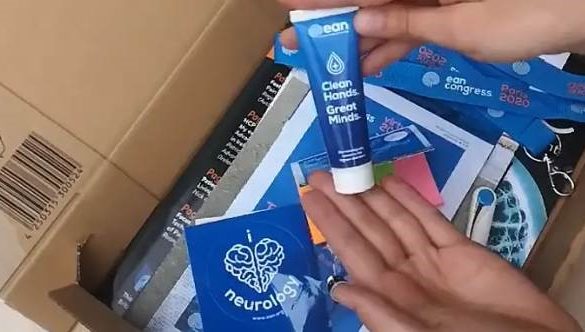
This year for the very first time, EAN plans to hold a new form of a career development session. The “Coffee with you” session is your chance to chat with Professors in a closed, live-streamed, meeting.
Every year, EAN Ethics and Quality Task Force collects and analyses your feedback regarding the quality of the sessions attended during the EAN congress.
In this paper, Dinkin et al., describe two patients who developed cranial neuropathies within days of respiratory symptoms related to SARS-CoV-2 infection and were found to have abnormal perineural or cranial nerve findings on MRI.
In this study recently published in Radiology, the authors describe brain magnetic resonance imaging findings in patients in the intensive care unit with COVID-19 pneumonia.
In this paper, the authors report the case of a 40-year-old man who developed acute brainstem dysfunction 3 days after hospital admission with symptoms of COVID-19 infection.
In order to inform the neurological community and patients, the Italian Association of the Peripheral Nervous System (ASNP), the Italian Society of Clinical Neurophysiology (SINC) and the Italian Society of Neurology (SIN) have developed a joint document to guide best practice for managing patients with immune-mediated neuropathy during the global spread of COVID-19.
This paper, recently published in Revue Neurologique, summarises recommendations for the care of neuromuscular patients during the COVID-19 pandemic outbreak from the French Rare Health Care for Neuromuscular Diseases Network (FILNEMUS).
In this consensus statement recently published in Neuro-Oncology, an international group of experts present mitigation strategies and treatment guidance for patients suffering from high grade gliomas (HGG) during the COVID-19 pandemic.
Most medical centres are postponing elective procedures and deferring non-urgent clinic visits to conserve hospital resources and prevent spread of COVID-19.
In this review, the authors explore the risk of COVID-19 in PD patients in terms of susceptibility to severe disease, impact on PD disease severity, potential long-term sequelae, and difficulties of PD management during this outbreak.
In this correspondence recently published in Lancet Neurology, the authors report the results of the pilot phase of an investigation of effects of COVID-19 among Italian people with multiple sclerosis, based on a core dataset collected from treatment providers through a specifically designed web-based case report form.
In this paper, the authors report a patient treated with natalizumab for relapsing-remitting MS who developed COVID-19 and recovered in a few days without complications.
In this case report recently published in Neurology, Barzegar et al. present the case of a 42-year-old woman affected by relapsing-remitting MS treated with fingolimod who was diagnosed with COVID-19 and had a favourable outcome.
In this retrospective multicentre cohort study, just published in JAMA, the authors describe the association between use of hydroxychloroquine, with or without azithromycin, and clinical outcomes among hospital inpatients diagnosed with COVID-19.