


 by Anna Sauerbier
On 26 November the Science and Technology Options Assessment (STOA) committee of the European Parliament (EP) organised a meeting entitled:
UNDERSTANDING THE HUMAN BRAIN – A new era of big neuroscience
Understanding… Continue Reading
by Anna Sauerbier
On 26 November the Science and Technology Options Assessment (STOA) committee of the European Parliament (EP) organised a meeting entitled:
UNDERSTANDING THE HUMAN BRAIN – A new era of big neuroscience
Understanding… Continue Reading 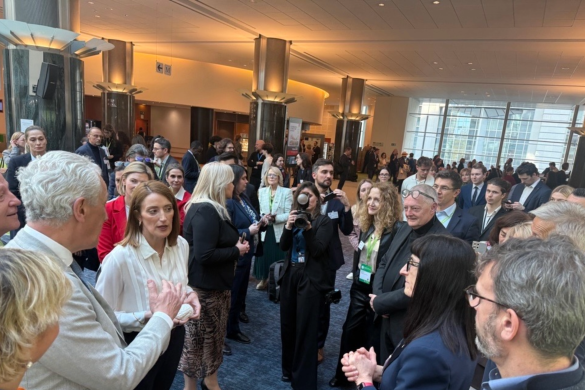
The European Parliament marked Brain Health Day: Prevention, Policy, Progress with a high‑level programme hosted by MEP Angelika Winzig, bringing renewed political attention to Europe’s urgent need for an integrated brain health strategy.
Latest Posts
-
by Anna Sauerbier
On 26 November the Science and Technology Options Assessment (STOA) committee of the European Parliament (EP) organised a meeting entitled:
UNDERSTANDING THE HUMAN BRAIN – A new era of big neuroscience
Understanding… Continue Reading
-
The EFNA MEP Interest Group on Brain, Mind and Pain organised a breakfast meeting on 29th November 2016 from 8.30 – 9.30 at the European Parliament, Brussels. The meeting addressed “Make work work” aiming at improving access to employment for… Continue Reading
-
News from EAN member societies
3rd congress of the Association of Neurologists of Bosnia and Herzegovina
Report by Prof Jasminka Đelilović – Vranić, President of the Organizing Committee The 3rd congress of the Association of Neurologists of BiH was held on November 3-5, 2016 in Sarajevo, Bosnia and Herzegovina. The congress brought together more than 300… Continue Reading -

 by Prof. Dr. Claudia Sommer
Teaching courses are designed to convey knowledge on a topical area within Neurology, with the ultimate aim to help the attendees to better understand this area, so that with this enhanced knowledge they will improve… Continue Reading
by Prof. Dr. Claudia Sommer
Teaching courses are designed to convey knowledge on a topical area within Neurology, with the ultimate aim to help the attendees to better understand this area, so that with this enhanced knowledge they will improve… Continue Reading -
 EAN Congress newsTop Articles
Neurological News from the Netherlands – the land of the 3rd EAN Congress: Neuro-oncology
 By Anja Gijtenbeek, on behalf of the Dutch Society of Neuro-Oncology
The diagnosis and care of patients with neurological malignancies or neurological complications of systemic cancer pose many challenges, and requires multidisciplinary expertise.
Nearly 25 years ago, two founding fathers… Continue Reading
By Anja Gijtenbeek, on behalf of the Dutch Society of Neuro-Oncology
The diagnosis and care of patients with neurological malignancies or neurological complications of systemic cancer pose many challenges, and requires multidisciplinary expertise.
Nearly 25 years ago, two founding fathers… Continue Reading -
 InterviewsTop Articles
Interview with Mr. F. Destrebecq- Executive Director of the European Brain Council (EBC)
David B. Vodušek (DV): Can you kindly illustrate how the idea of creating NBCs came about and what their intrinsic value is to EBC? F. Destrebecq (FD): The EBC has been founded to catch the ear of the EU decision makers. However, soon it became clear that by focusing only on Brussels, the EBC would not be able to achieve its full potential of influence. -
 As in the previous year, EANpages asked EAN committee members, panel chairs, and invited speakers which session one should not miss at the upcoming congress in Amsterdam 2017. Please find their answers below!
 -
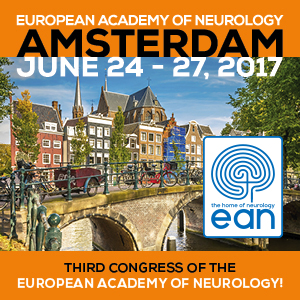
 Abstract Submission Deadline is January 13, 2017!
In order to submit an abstract, please log in/register on www.ean.org/amsterdam2017 and go to your MyEAN area. There you can update your personal data and also find a link to the abstract submission… Continue Reading
Abstract Submission Deadline is January 13, 2017!
In order to submit an abstract, please log in/register on www.ean.org/amsterdam2017 and go to your MyEAN area. There you can update your personal data and also find a link to the abstract submission… Continue Reading -
 Paper of the MonthFeatured Slider
Paper of the month: Safer effective treatment for Ménière’s disease
For January 2017, we have selected: Patel M, Agarwal K, Arshad Q, et al. Intratympanic methylprednisolone versus gentamicin in patients with unilateral Ménière’s disease: a randomized double-blind, comparative effectiveness trial. Lancet Neurol 2016;388:2753-2762. Disabling vertigo attacks and hearing loss are characteristics of Ménière’s disease. In patients with severe and frequent vertigo spells, intratympanic injections of gentamicin have proved to be effective, but at the price of permanent vestibular damage and hearing loss. -
 Kazakhstan, officially the Republic of Kazakhstan (Kazakh: Қазақстан Республикасы), is located at the center of the Eurasia continent. On the north and west sides, Kazakhstan shares borders with Russia, on the east with China, and on the south with Kyrgyzstan, Uzbekistan, and Turkmenistan. Kazakhstan is a huge country, being at the 9th place in the world for its size.
 -
 The objective of the “Clinical Fellowship Programme” is to provide a well- defined clinical observational experience in a department with recognised expertise in a specific field.
With this programme, neurologists that are still in the process of training, or recently… Continue Reading -
 Eur J Neurol
European Journal of Neurology – FREE Access to ALL European Journal of Neurology Reviews
Do not miss the highly popular Reviews and Invited Reviews published regularly in the European Journal of Neurology. Herewith the latest Reviews: -
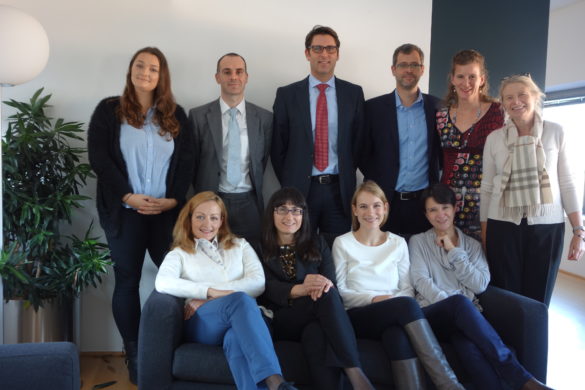 Dear EAN members, dear readers, as EANpages Editor, it is my privilege to send you a few lines at the end of this 2016, which has been a very important and special year for EANpages. Together with the launch of… Continue Reading
 -
 Vansteensel et al. reported a new technique for communication that could be applied to oral-disabled patients. By implanting electrodes to read brain activity in the sensorimotor cortex, and an interface with a subcutaneous transmitter in the thorax, a patient with ALS was able to communicate wireless controlling a computer typing program.
 -
 Executive PageFeatured Slider
President’s Page: On the value of European health care funding for neurological patients
European institutions are sometimes discredited and put into questions. This is particularly true in these times of populistic political movements which try to steer the wheel of European unification backwards. Reasons given by opponents are that ‘European efforts are considered too slow, too burocratic and too inflexible’. ‘There are too many cooks preparing the meal’. Sometimes we hear this also from scientists. The logical conclusion is to spend the money at home in their own countries. The latter view is sometimes even expressed by people who in principle share the European perspective. Populistic politicians go so far to even question the whole EU project. In this respect medical research community can make an argument and a big contribution to the understanding why the EU is important.