Magdalena Mroczek, Basel, Switzerland
Hosting department: Department of Clinical Neurophysiology, Aarhus University Hospital, Aarhus, Denmark
Supervisor: Prof. Hatice Tankisi
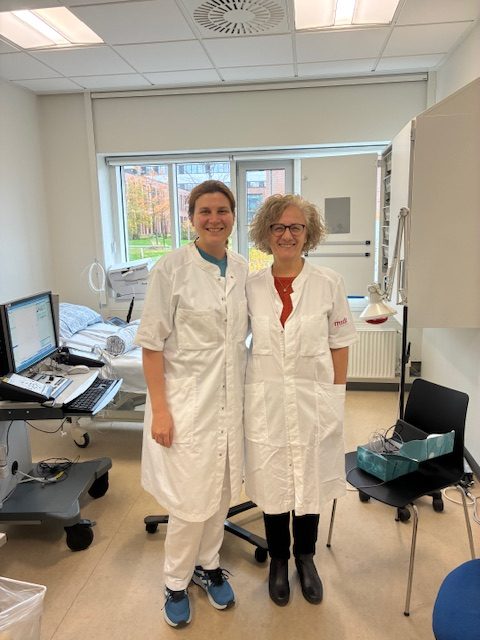
In 2025, thanks to the EAN Research Training Fellowship I was given the opportunity to undertake six months of research staying at the Department of Clinical Neurophysiology, Aarhus University Hospital, Aarhus, Denmark. The research group, led by Prof. Hatice Tankisi, focuses on the application of peripheral nerve, muscle, and cortical excitability tests using threshold tracking and motor unit number estimation methods. Prof. Tankisi is my former mentor from the EAN Mentorship Programme. In 2022/2023, I had already collaborated with her on a project investigating the effects of sleep deprivation on cortical excitability using the threshold tracking method (DOI: 10.1016/j.cnp.2023.12.001).
During the fellowship, I had the opportunity to apply peripheral nerve excitability techniques in the project ‘The Role of Ischemia in the Development of Diabetic Neuropathy’. The overall aim of the study was to examine the mechanisms underlying the development of diabetic neuropathy in patients with type 2 diabetes. Using the Qtrack programme designed for excitability testing, we examined a range of parameters in both motor and sensory nerves (currently, only data on ischaemia resistance in motor nerves are available). The study included over 40 people with type 2 diabetes and more than 20 healthy controls. Preliminary analyses confirmed the validity of the applied methodology with a relatively short period of ischaemia and two parameters showed significant differences between healthy controls and diabetic patients after ischaemia. We are continuing the data analysis, and the results were presented at the EAN Congress as an ePoster (Ischemia resistance in the pathophysiology of early diabetic motor and sensory polyneuropathy). Furthermore, we have an advanced manuscript draft that we are planning to submit shortly.
During the fellowship, I also participated in several workshops and conferences organised by Prof. Tankisi and her team at the Department of Clinical Neurophysiology, including ‘Emergent Technologies in Clinical Neurophysiology’, the ‘2025 Aarhus Excitability Workshop’, and the ‘Hands-on Teaching Course – Quantitative EMG and Neuromuscular Ultrasound’. These events offered me unique opportunities to meet leading experts in clinical neurophysiology and to learn advanced and emerging electrophysiological techniques. I was warmly welcomed by the whole group at the department and participated in the Journal Clubs and Research Meetings.
I would like to express my sincere gratitude to Prof. Hatice Tankisi and her research group for enabling me to complete this fellowship, for hosting me in their laboratory, and for their constant support throughout the project. I am deeply grateful to Prof. Tankisi for finding the time to supervise the work despite her demanding clinical and research duties. I would also like to thank all the patients who participated in the study. I hope that our research will not only contribute scientifically but also have a meaningful impact on improving diagnosis and monitoring treatment response in diabetes.
Finally, the fellowship also offered me the chance to experience Danish hygge culture, explore the beautiful city of Aarhus, and discover why it is known as “The City of Smiles”.
Markus Ponleitner, Vienna, Austria
Hosting department: University Hospital Leipzig, Department of Neurology, Leipzig, Germany
Supervisor: Dr Christa-Caroline Bergner, Dr Wolfgang Köhler
I want to extend my heartfelt gratitude to the European Academy of Neurology (EAN) for supporting me during my Research Fellowship at the leukodystrophy outpatient clinic at the University Hospital Leipzig. During my training to become a neurologist, I had the opportunity to care for patients afflicted with rare hereditary disorders including X-linked adrenoleukodystrophy (X-ALD), which kindled my curiosity and passion for the fascinatingly complex and heterogeneous leukodystrophies.
Alongside clinical work in the outpatient clinic, where I was able to get to know and care for many patients with X-ALD, I was able to collaborate on several scientific projects investigating this and related disorders. These ranged from preclinical projects with a focus on histopathology to clinical research employing biomarkers and the development of advanced machine-learning models to classify MRI data. Chief among them, I was involved in the investigation of the natural history and disease progression of adult-onset cerebral adrenoleukodystrophy (cALD), a devastating cerebral inflammatory variant of this enigmatic disease. Here, we analysed MRI data to find predictors of different rates of disease progression and correlations with other biomarkers.
I want to use this opportunity to thank my supervisors, who created a very welcoming and stimulating environment, were always open to questions and never failed to provide valuable insights and feedback. I quickly felt part of the team and want to express my deep gratitude towards all the colleagues I was so fortunate to work with during my fellowship. And finally, I would like to acknowledge the support of the EAN, which enabled me to embark on this fantastic journey.
Claudia Ledda, Turin, Italy
Hosting department: UCL Queen Square Institute of Neurology, Neurogenetics Research Lab, London, UK
Supervisor: Prof. Dr Francesca Magrinelli
I am deeply grateful to the European Academy of Neurology for granting me the opportunity to carry out a Research Training Fellowship at the UCL Queen Square Institute of Neurology and the National Hospital for Neurology and Neurosurgery (NHNN) in London. I am especially thankful to Dr Francesca Magrinelli for her generous supervision and for welcoming me into the exceptional neurogenetics and movement disorders team.
My research project focused on the deep phenotyping and genotyping of paroxysmal movement disorders (PxMD), a heterogeneous group of rare conditions including paroxysmal dyskinesias and episodic ataxias. The aim was to better define the genetic and phenotypic spectrum of these disorders through next-generation sequencing (NGS) and detailed clinicogenetic correlations.
During my fellowship, I was actively involved in the analysis of NGS data, including whole-exome sequencing (WES), with a focus on rare and ultra-rare variants of several genes involved in PxMD, including but not limited to PRRT2, SLC2A1, PNKD, TMEM151A, TBC1D24, ECHS1, PDHA1, PDE2A, KCNJ10, KCNMA1.
I learned how to use population and disease databases, pathogenicity prediction tools, conservation metrics and bioinformatic pipelines for variant filtering, prioritisation and interpretation, and I contributed to the identification of potential disease-causing mutations in candidate genes. In parallel, I strengthened my wet laboratory skills through hands-on work in DNA extraction from blood and saliva, PCR, and Sanger sequencing for NGS variant validation and segregation analysis.
Clinically, I had the privilege to attend movement disorder and botulinum toxin clinics led by world-renowned experts and to observe a holistic and highly integrated approach to patient care. I was exposed to a wide variety of rare neurological conditions and had the chance to witness the multidisciplinary collaboration between neurologists, geneticists, physiotherapists, and other specialists — an experience that enriched both my clinical knowledge and my vision of patient management.
UCL also hosts regular Gowers Grand Rounds and Brain Bank clinicopathological conferences. Additionally, the Movement Disorders Department organised video sessions, journal clubs, and Basal Ganglia Club meetings, all of which I attended regularly and found extremely educational.
This fellowship also had a strong personal impact. Working in a dynamic and international research environment allowed me to engage in fruitful scientific discussions and to broaden my professional network. Living in London was an additional source of inspiration, with its vibrant scientific community and rich cultural life.
Several collaborative research projects are currently underway, including: a study on a cohort with biallelic PRRT2 variants; a screening of a large cohort with idiopathic (mainly cervical) dystonia for repeat expansion in RFC1 (CANVAS); a phenotypic and genotypic characterisation of movement disorders associated with various genes, including NDUFV1, ECHS1, SLC16A2, and TMEM151A; and the study of two families carrying KCNJ10 variants, with accompanying patch-clamp analyses.
I presented part of this work, titled ‘Defining the pheno-genotypic spectrum of autosomal recessive PRRT2-related disorder’, at the Italian National Congress on Movement Disorders (LIMPE).
All future publications arising from this work will acknowledge the support of the EAN.
In conclusion, this fellowship has been a truly transformative experience, both scientifically and personally. I highly encourage other young neurologists to apply for the EAN Research Training Fellowship, which offers a unique opportunity for growth, collaboration, and international exposure.