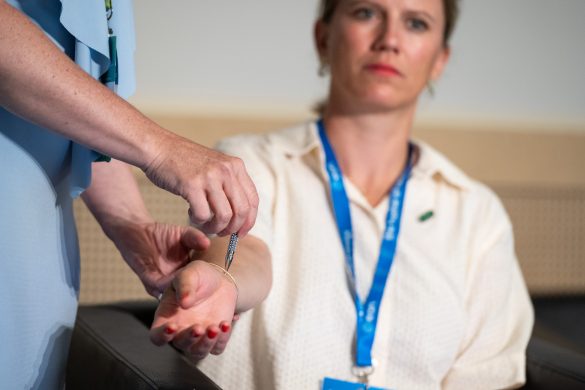
On 29 September 2026, Vagal Foods, a participatory installation at Vienna Design Week, welcomed visitors to explore the relationship between food, the nervous system and social connection. Created by independent brain health researcher Andra Bria together with designers, artists and scientific advisor Dr Isabella Anderson-Wagner, the installation invited visitors to taste, touch and share food around a communal wood table tracing the path of the vagus nerve.
In the interview below, Bria discusses the inspiration behind the project, visitors’ responses and the role of everyday experiences in communicating brain health.
eanNews: Most people don’t think about their vagus nerve when they sit down to eat. What made you want to bring this part of our biology into an everyday experience like sharing a meal?
Andra Bria (AB): It started with an honest look at my own behaviors and habits, and at the gap between knowing what supports health and being able to act on it. For the past few years, I struggled to make a proper meal a regular part of my day, so I often relied on ordered food or rushed through the day without time to cook.
At some point, I made a deliberate decision to fix this problem, and started to spend real time cooking, for myself and for the people I love. I quickly realized how much power there is in food.
We talk a lot about prevention – but in real life, many of us sleep poorly, don’t have time to exercise, or to sit down for a proper lunch.
I think prevention is also about what you can fit into your own schedule, not about ticking every box. That eases the pressure, and you can be glad that you did your part with what you could.
Once I saw that my own possibility lay in eating with a bit more intention and cooking at home, I started asking how to optimize what I ate: which ingredients keep me sharp, alert and energetic? And because I was studying brain health, the next question was which foods have real evidence for brain health? That is where I started diving deeper into the science.
I found a randomized trial in which a Mediterranean diet enriched with extra virgin olive oil was associated with better cognitive performance in older adults over about four years than a low-fat control diet. And a Stanford trial in healthy adults showed that a diet rich in fermented foods increased gut microbiome diversity and lowered inflammatory markers.
The direct evidence for the brain is still emerging, as the field of nutritional psychiatry itself acknowledges, but the gut and the brain are in constant conversation.
The vagus nerve came last. It is the main wire between the gut and the brain, and about 80% of its fibres carry signals up to the brain.
It entered the picture when I realized that how we eat matters too, not just what we eat: calmly or in a rush, together or alone, and even the texture of the food.
That is what became Vagal Foods, a table of three stations where people can feel these ideas. Crunch & Tang, a kimchi tasting, is about fermented foods and the gut. Warmth & Oil, olive oil and bread, is about slowing down. By Hand, chocolate shared piece by piece with the person next to you, is about connection. Each station is tied to a line of research on how eating, the gut and the nervous system relate. People taste, slow down and share, and only then hear the science behind it.
eanNews: The vagus nerve has become a popular topic in conversations about stress, wellbeing and health, sometimes with claims that go beyond the evidence. How did you navigate the line between making neuroscience engaging and communicating it responsibly?
AB: This is the question I worked on most. The vagus nerve is real and important, but social media has turned it into a stress cure, with promises about ‘resetting’ it that the evidence does not support. I wanted the table to be evocative without making claims it could not defend.
My working rule was poetry on the table, rigor in the back pocket.
What guests read on the cards laid out on the table was simple and sensory. But behind every sentence there was a citation I could hand to a sceptical neurologist. The strongest anchors are the Mediterranean diet trials for the olive oil, the Stanford study showing that fermented foods increase microbiome diversity, and research linking social connection to vagal tone.
I also wrote a short list of claims we can and cannot make and kept to it, and a scientific advisor (thank you, Ass. Prof. Mag. Dr. Isabella Anderson-Wagner) reviewed the menu and the wording before the event. Above all, I avoided promising outcomes. The table does not treat anything; it offers people a way to pay attention to their own bodies, and that is a claim I can stand behind.
eanNews: Now that Vagal Foods has met its audience, what did you hear, see or learn that you hadn’t anticipated? Did the public’s response challenge any of your assumptions about how people engage with brain health?
AB: So, the hook was easy. Many people came to the Vagal Foods installation because they had heard chocolate was being served, and that was true. But then they saw a large table with wooden branches running through the middle, standing for the nerve, and they grew curious.
What moved me most was who engaged. A primary school group came to explore, and the children were taking notes. When I asked one of them whether they understood, they immediately told me what the vagus nerve is. A teenager explained it to her colleagues.
A member of my own team told me she had not known about this nerve before and said something that stayed with me: I was so surprised that most people didn’t know the vagus nerve exists. Why do we search for the stars when we don’t know what happens inside our own bodies? It is true. Our own biology is so fascinating, and yet we often tend to look for answers outside ourselves.
The rhythm of the experience also kept people engaged. I walked each group through the three stations, and because the table was large, there was time between tastings to actually feel the flavor and think about it. The kimchi, the olive oil and the chocolate were made from pure ingredients, so the tastes were strong and lasted long enough to notice.
At the By Hand station, couples understood that they had to share the chocolate, so closeness and touch became part of the experience. I could hear them say: wait, we need to share the piece now. Social connection is one of the things linked to higher vagal tone.
eanNews: Brain health communication often focuses on telling people what they should know or do. Your project takes a different route. What needs to change in the way we communicate brain health if we want people not just to understand it, but to connect with it in their everyday lives?
AB: Indeed, much of health communication tells people what they should know or do: sleep more, eat better, reduce stress. It is accurate and often ignored, and that’s because advice without experience rarely sticks, and also – it can sound like blame.
I think a few things need to change:
First, start from experience and let understanding follow. A taste, a scent, or a shared moment gives people something to attach the science to. We need to move health communication into the places where life already happens: at the dinner table, in the workplace, during a walk – and also build it with people who live there, not only for them.
Connection is part of it too. The third station of the Vagal Foods table was about doing something together, because social ties are among the strongest influences on how we feel. If we want people to connect with brain health, we have to make it feel less like homework, and more like something they already do, only with more attention, and yes, preferably, together.
Last, but not least, stay honest about the evidence. People can tell the difference between a claim that is trying to sell something and one that is trying to share something.
Part of the answer, I believe, is to create experiences that stay with us, that get remembered. Most of what we consume today is predictable, repeatable, often AI-generated. In an age of information overload, what keeps people engaged in the end is not the information – it’s a feeling.
Thank you to: Allan Berger, Sabine Rauth, Michael Salge, and all the participating artists and partners.
Read more about Vagal Foods: Vagal Foods — Feed Your Brain · La Table